The Rise of Multi-Agent Systems
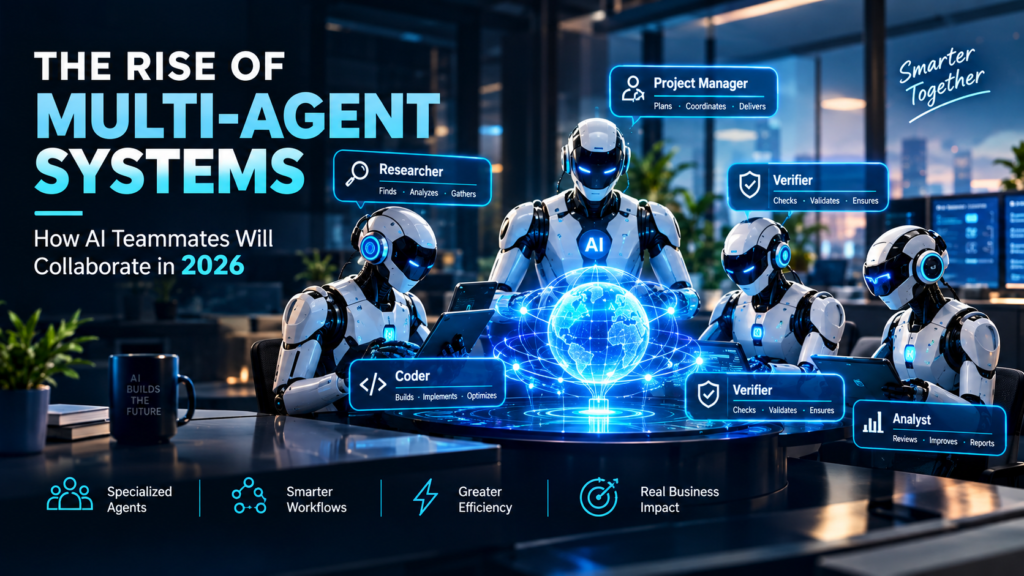
Artificial intelligence is entering a new phase in 2026. Instead of relying on one AI model to handle an entire workflow, businesses are increasingly exploring multi-agent systems where several specialized AI agents work together toward a shared objective.
Think of it as a digital workplace. One AI agent researches information, another writes code, another checks the result, and another coordinates the entire process. Each agent has a defined responsibility, while the overall system connects their individual capabilities.
This approach is changing the way organizations think about AI automation. The goal is no longer simply to build a smarter chatbot. Instead, companies are experimenting with AI teammates, autonomous agents, agentic workflows, and collaborative AI systems capable of completing complex multi-step tasks.
By dividing work between specialized agents, organizations can create AI workflows that are more modular, observable, and adaptable. Frameworks such as LangGraph and AutoGen have also helped developers experiment with these collaborative architectures.
1. From Solo Models to Digital Assemblies: The Shift to Specialized AI Roles
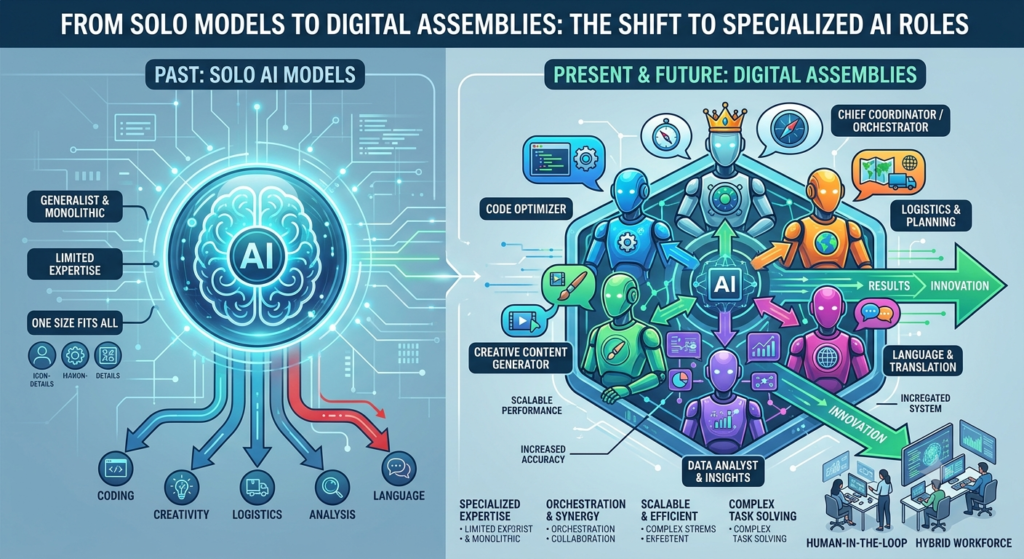
For several years, the dominant AI model was relatively simple: give one large language model a prompt, receive an answer, and continue the conversation.
That approach works well for many tasks, but complicated business processes often involve several different types of work. Research, planning, coding, verification, documentation, and decision-making require different capabilities.
This is where multi-agent AI becomes interesting.
Instead of asking one model to perform everything, developers can create a collection of specialized agents. Each agent receives a particular role and can interact with other agents as part of a larger workflow.
What Does a Team of AI Agents Look Like?
A hypothetical software-development workflow could contain:
- Researcher Agent: Collects relevant technical information.
- Planner Agent: Converts requirements into actionable tasks.
- Coder Agent: Writes or modifies software.
- Testing Agent: Runs tests and identifies problems.
- Verifier Agent: Reviews the output for errors.
- Project Manager Agent: Coordinates tasks and monitors progress.
The advantage is modularity. If the testing process needs improvement, developers can modify the testing agent without redesigning the entire system.
This division of responsibilities can also make complex workflows easier to monitor because each agent has a defined purpose and output.
Why Specialized AI Agents Matter
A general-purpose AI model can perform many tasks, but asking one system to simultaneously research, plan, execute, verify, and manage a project can make workflows difficult to control.
A specialized architecture separates those responsibilities.
For example, a research agent might gather information before handing structured findings to a writing agent. A verification agent could then review the generated content before the final result reaches a human employee.
This creates an AI orchestration layer between individual models and the final business outcome.
Frameworks Behind Digital AI Workforces
Developers are building these systems with frameworks designed for agent orchestration and workflow management.
Two frequently discussed technologies are LangGraph and Microsoft AutoGen. They provide developers with tools for creating workflows where multiple AI components can communicate, execute tasks, and respond to changing conditions.
The broader trend is toward modular AI systems, where an organization can assemble different models and tools depending on the task instead of relying on one universal AI worker.
2. The Mechanics of Collaboration: Agent-to-Agent Protocols & Communication
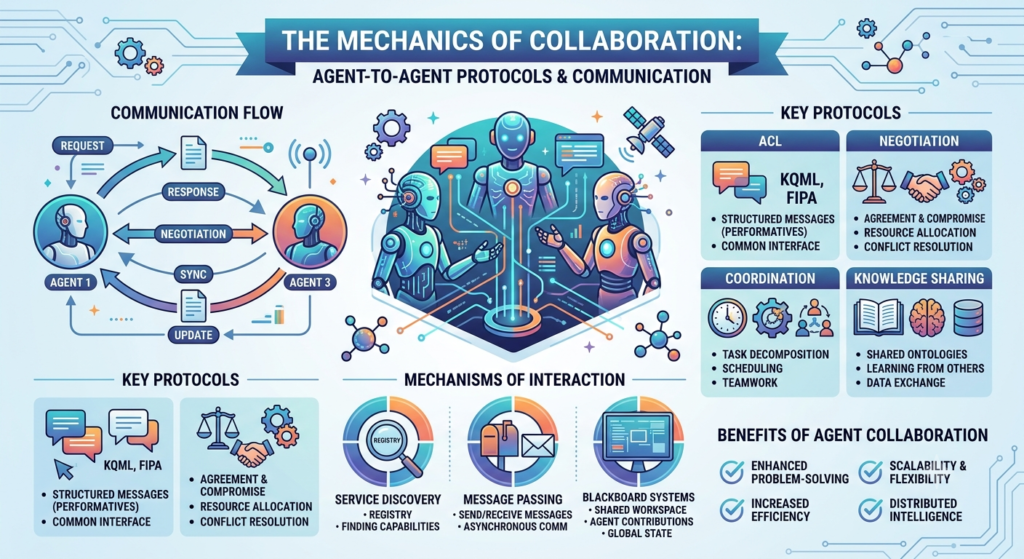
Creating multiple AI agents is only half the challenge. The bigger question is: How do these agents communicate?
A multi-agent system needs a mechanism for exchanging instructions, information, status updates, and results.
This is where agent-to-agent communication protocols become important.
Message-Passing Architecture
One common approach is message passing.
An agent completes a task and sends structured information to another agent. The receiving agent processes that information and produces another output.
For example:
Customer request → Research Agent → Analysis Agent → Recommendation Agent → Human approval
Each stage can have its own instructions, tools, permissions, and responsibilities.
Rather than having every agent access everything, organizations can design controlled communication channels between them.
Shared Memory and Vector Databases
AI agents may also need access to shared information.
A vector database can store documents, previous results, product information, internal knowledge, or other context in a format that AI systems can retrieve semantically.
This can provide agents with a form of shared organizational memory.
For instance, a research agent might retrieve information from a company’s knowledge base and pass relevant findings to an analyst agent. The analyst does not necessarily need to repeat the entire research process.
However, shared memory also creates security and accuracy concerns. If incorrect information enters the shared knowledge layer, multiple agents may rely on it.
Consensus Between AI Agents
Some multi-agent architectures can use multiple agents to review the same problem.
For example:
- Agent A creates an initial solution.
- Agent B independently reviews it.
- Agent C searches for contradictions.
- A coordinator evaluates the responses.
- The system produces a final result.
This can create a form of AI consensus mechanism.
It does not automatically guarantee correctness. Multiple agents can still share the same underlying model limitations or propagate the same incorrect assumption. Nevertheless, independent verification can be useful for workflows where accuracy matters.
The Rise of Agent-to-Agent Standards
As organizations deploy agents from different vendors and development teams, interoperability becomes increasingly important.
Google’s Agent2Agent (A2A) protocol is one example of an industry effort aimed at enabling AI agents to communicate and collaborate across different systems.
The long-term significance of such standards is straightforward: companies may not want every AI agent to come from the same platform.
Standardized communication could allow an internal finance agent to interact with an external supplier agent, provided the necessary permissions, identity verification, and security controls are established.
3. Human in the Loop: Redefining Management in an Agentic Workplace
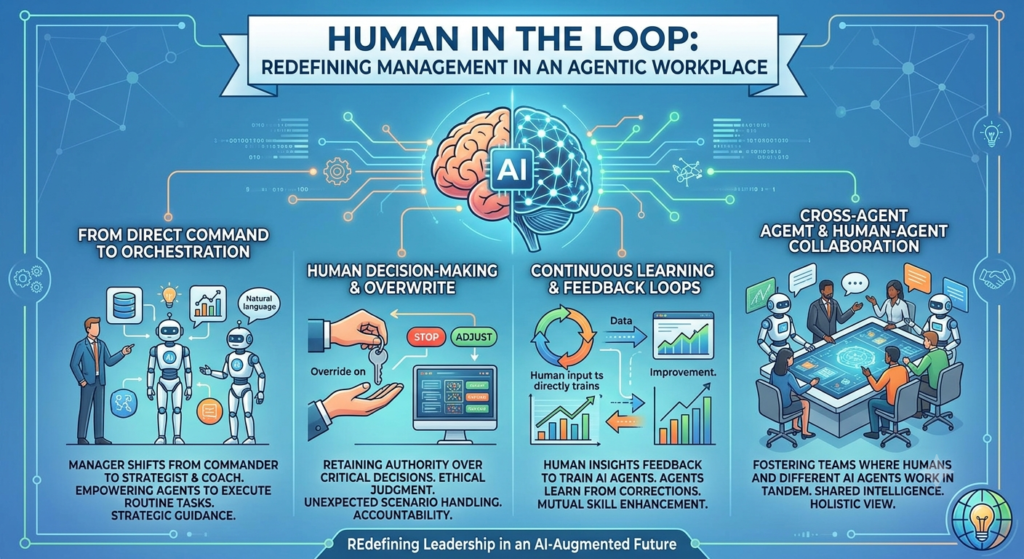
The rise of AI teammates does not necessarily mean removing humans from the workflow.
Instead, it may change what humans do.
In traditional automation, people often execute tasks while software handles repetitive steps. In an agentic workplace, employees could increasingly become supervisors of AI systems.
This creates what can be described as the manager-of-agents paradigm.
From Doing the Work to Managing the Workflow
Imagine a marketing manager responsible for launching a campaign.
Instead of personally completing every activity, the manager could supervise several AI agents:
- A research agent analyzes the target market.
- A content agent creates campaign drafts.
- A design agent prepares creative concepts.
- An analytics agent studies campaign performance.
- A compliance agent checks claims and restrictions.
The human manager remains responsible for defining objectives, setting boundaries, reviewing important decisions, and approving sensitive actions.
This changes the employee’s role from direct execution toward AI orchestration, supervision, quality control, and governance.
Approval Bottlenecks for Sensitive Tasks
Not every action should happen automatically.
Organizations can introduce human-in-the-loop controls for activities involving financial transactions, legal commitments, confidential information, hiring decisions, or external communications.
For example, an AI agent might prepare a supplier contract but require human approval before sending it.
This creates a controlled workflow:
AI prepares → AI verifies → Human approves → AI executes
Such approval gates can reduce the potential impact of an incorrect autonomous decision.
Reskilling the Modern Workforce
The growth of agentic AI will also create demand for new skills.
Employees may need to understand:
- AI workflow design
- Prompt and instruction engineering
- AI output verification
- Data governance
- Cybersecurity
- Agent permissions
- Automation management
- AI ethics and compliance
The important skill may not be knowing how to perform every task manually. It may increasingly be knowing how to design, supervise, and improve systems that perform those tasks.
4. Trust, Security, and Cross-Organizational Handoffs
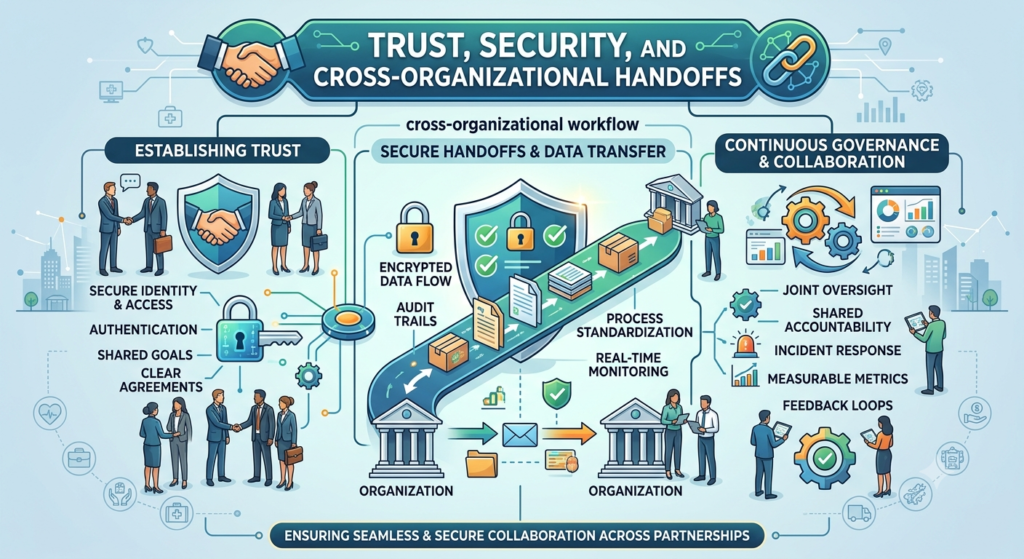
More autonomy introduces another major challenge: trust.
If an AI agent can access business systems, communicate with other agents, and make decisions, organizations need to know exactly who the agent is, what it can access, and what it is allowed to do.
This makes AI security an essential part of multi-agent architecture.
Cryptographic Agent Identity
Future enterprise AI systems will need mechanisms for establishing agent identity and authorization.
An agent should not simply announce that it belongs to a particular company. Systems need reliable ways to authenticate it and determine which resources it can access.
Concepts such as cryptographic credentials, authentication, authorization, access tokens, and least-privilege permissions can become important components of agent infrastructure.
An agent responsible for preparing reports should not automatically have permission to transfer money or modify financial records.
Preventing Cascade Errors
One of the biggest risks in collaborative AI systems is a cascade error.
Imagine that one agent generates incorrect information. A second agent assumes that information is accurate and uses it for analysis. A third agent uses that analysis to make a recommendation.
The original mistake can therefore travel through the entire workflow.
Organizations can reduce this risk through:
- Independent verification
- Source attribution
- Confidence thresholds
- Human approval
- Structured outputs
- Audit logs
- Permission boundaries
- Automated testing
- Monitoring and anomaly detection
The objective is not simply to make individual agents smarter. It is to make the entire AI system resilient to failure.
Cross-Company AI Transactions
The most interesting development may occur when agents from different organizations begin interacting.
Consider an automated procurement scenario.
A company’s purchasing agent could identify a supplier, request pricing, compare offers, negotiate predefined terms, and send the final proposal to an internal approval system.
The supplier could have its own AI agent responding to these requests.
This creates an agent-to-agent business transaction.
However, several questions immediately appear:
- How does each agent prove its identity?
- Who authorized the transaction?
- What information can the agents access?
- What happens if an agent makes an unauthorized commitment?
- How are disputes handled?
- Who is responsible for an incorrect decision?
These questions demonstrate why AI interoperability must develop alongside AI governance and security standards.
What Multi-Agent Systems Could Mean for Businesses in 2026
The practical impact of multi-agent AI may extend across almost every knowledge-based industry.
Potential applications include:
Software Development
AI agents can collaborate on requirements, coding, debugging, testing, documentation, and deployment.
Marketing
Research, content creation, campaign planning, analytics, and optimization can be divided among specialized agents.
Customer Support
One agent can understand the customer’s issue while another retrieves account information and another recommends a solution.
Finance
Agents can assist with financial analysis, reporting, reconciliation, and anomaly detection while sensitive actions remain subject to human approval.
Supply Chain
Procurement agents could monitor inventory, communicate with suppliers, compare quotations, and prepare purchasing recommendations.
Enterprise Research
Research agents can gather information while analyst and verification agents organize, compare, and validate findings.
Challenges That Could Shape the Multi-Agent Future
Despite the excitement surrounding AI teammates, multi-agent systems are not automatically better simply because more agents are involved.
Adding agents also adds complexity.
Organizations will need to address:
- Reliability: Agents can still generate incorrect information.
- Cost: Multiple AI calls can increase computational expenses.
- Latency: Complex workflows may take longer than a single model response.
- Security: More agents mean more potential access points.
- Coordination: Poorly designed workflows can create unnecessary communication.
- Accountability: Businesses need clear responsibility for autonomous decisions.
- Data privacy: Agents may process sensitive organizational information.
- Observability: Companies need to understand what happened inside an autonomous workflow.
The most successful systems will therefore likely focus on well-defined workflows rather than maximum autonomy.
The Future of AI Is Becoming More Collaborative
The development of multi-agent systems represents an important shift in artificial intelligence.
Instead of thinking about AI as one enormous digital brain, organizations are beginning to explore AI as a network of specialized digital workers.
One agent may research. Another may write. Another may test. Another may verify. A coordinator can connect these activities, while humans establish objectives, permissions, and accountability.
In 2026, this concept is moving from an experimental idea toward a significant direction in enterprise AI development. Frameworks, communication protocols, shared memory systems, and security infrastructure are all contributing to the emergence of more collaborative AI architectures.
The biggest change may ultimately be organizational rather than technical. Companies will need to rethink how work is divided between humans and machines, how employees supervise autonomous systems, and how responsibility is maintained when multiple AI agents participate in a single decision.
The future of AI may therefore not be about finding one model capable of doing everything.
It may be about building AI teammates that know their roles, communicate with one another, work within defined boundaries, and collaborate with humans to accomplish complex goals.